
Your Mind Is the Enemy.
Vipassana at 19, and what ten days of silence rewires about who's actually running your day.
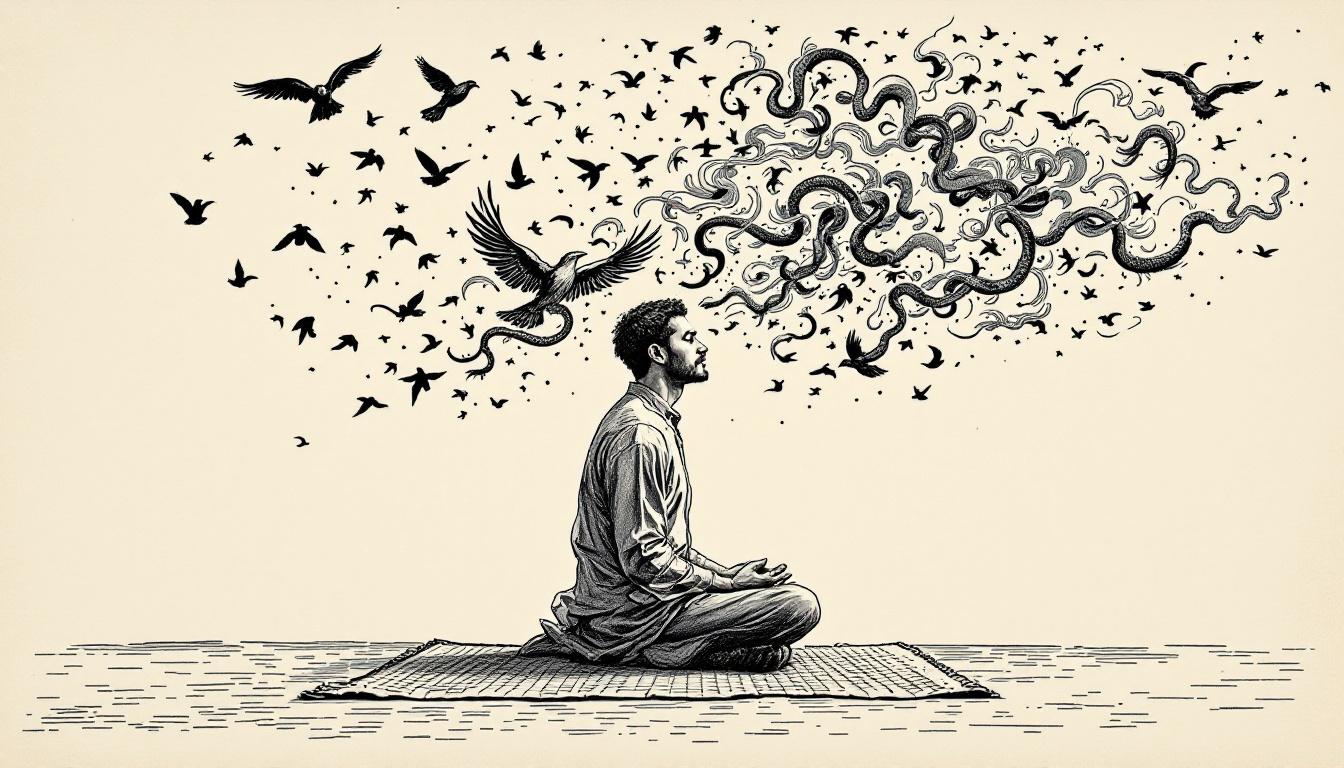
I went to a Vipassana retreat at 19. Ten days. No phone. No talking. No reading. No writing. No eye contact. Just sit, and watch what happens inside your head.
I wasn't there for enlightenment. I was there because I'd hit a wall I couldn't think my way around.
What I learned in those ten days has shaped almost every important decision I've made since. It also took me three more years to actually use what I learned. This letter is the short version of the story, and the longer version of the lesson. None of it is mystical. Most of it is mechanical. All of it is testable in your own week.
What the days actually look like.
You wake at 4am. You sit cross-legged on a cushion in a hall full of strangers, also silent. You watch your breath enter and leave for an hour. You eat in silence. You walk in silence. You sit again. And again. And again. Eleven hours of sitting, every day, for ten days.
The first three days are physical. Your back screams. Your knees give up. You shift forty times an hour and feel pathetic about it.
Then the body settles. And the real opponent shows up.
The opponent is your own mind.
Around day four, I figured out that the unbearable part of Vipassana wasn't the silence. It was being trapped in a room with the thing inside my head, with no way to distract from it.
For nineteen years I had been running from it. Music, scrolling, conversation, ambient noise, anything to avoid the feeling of just sitting with whatever was already happening in my skull. The retreat removes every escape.
What's left is the loop most people never look at directly. Random memories. Old grudges. Anxious projections. Insults you got in fifth grade. Things you didn't say. Things you regret saying. People you owe an apology to. Things you're afraid will happen. Things that probably won't happen but you're rehearsing anyway.
The mind is not a calm monastery. The mind is a panic room running thirty browser tabs of unfinished thoughts. Almost none of them are useful. Almost all of them are loud.
On day five I had the only thought that mattered. This is what's been running my life. I've been letting this run my life.
That was the lesson. Not "I should meditate more." Not "I should be more present." The lesson was: there is a thing inside my head that is not me, and it has been quietly making most of my decisions for nineteen years.
The mind is the enemy when you ignore it.
Most operator advice misses this. It treats the mind like an asset. Optimize your mind. Upgrade your mind. Train your mind.
Backwards. The mind is not a tool you sharpen. The mind is a process you supervise. The reason most people never stop chasing is that the mind is always one step ahead, generating the next thing to want, the next thing to fear, the next thing to fix.
If you ignore it, it runs you. Quietly, efficiently, in the background. You think you chose your career. You chose what your mind told you would feel safe. You think you chose your relationship. You chose what your mind told you would soothe an old wound. You think you chose the house, the car, the schedule. You chose what got the panic to quiet down for a minute.
The first move is not to silence the mind. The first move is to notice it.
What changed for me, after the retreat.
I came back from Vipassana believing I had figured something out. I had not. I had seen something, which is different. Seeing is the first half. Working with what you've seen is the second half, and it took years.
Three things eventually stuck. None of them require ten days of silence.
1. Two minutes of doing nothing, every morning.
Before the phone. Before the laptop. Just sit, eyes open or closed, and watch the first wave of thoughts arrive. You don't fight them. You don't try to be calm. You just notice what your mind decides to lead with. Most days, it's something stupid. A petty grievance, a status fear, an ambient anxiety. Notice it, name it, watch it pass. The point isn't to feel better. The point is to remember, every morning, that the voice in your head is not you.
2. Catch the bait.
The mind sends you bait constantly. You should be doing more. They didn't text back. You're falling behind. He's making more than you. The deal is going to fall through. When you spot the bait, name it. That's bait. Then keep doing whatever you were doing. The bait loses its grip the moment you label it. The mind hates being seen.
3. The body is the off-ramp.
When the mind is winning, runaway anxiety, runaway anger, runaway anything, you cannot think your way out. You can only move out. Walk for ten minutes. Lift something heavy. Take a cold shower. Hold a plank until you can't. The body interrupts the loop because the body, when you make it loud enough, is louder than the mind.
That's the whole protocol. No app. No subscription. No teacher.
The trap most people fall into.
When you start noticing the mind, your first instinct is to try to fix it. You read more books. You buy more journals. You try a new meditation app. You add a third morning routine.
This is the mind playing a longer game. It has tricked you into thinking that controlling the mind is another project to optimize. It isn't. The work is the opposite of project work. The work is to do less, watch more, and stop confusing the voice in your head with the truth.
The retreat showed me the process. The years after taught me to live with it. You don't need ten days of silence to start. You need two minutes, tomorrow morning, before the phone.
The mind is the enemy when you let it run unsupervised. It stops being the enemy the day you start watching it.
Shoh.